

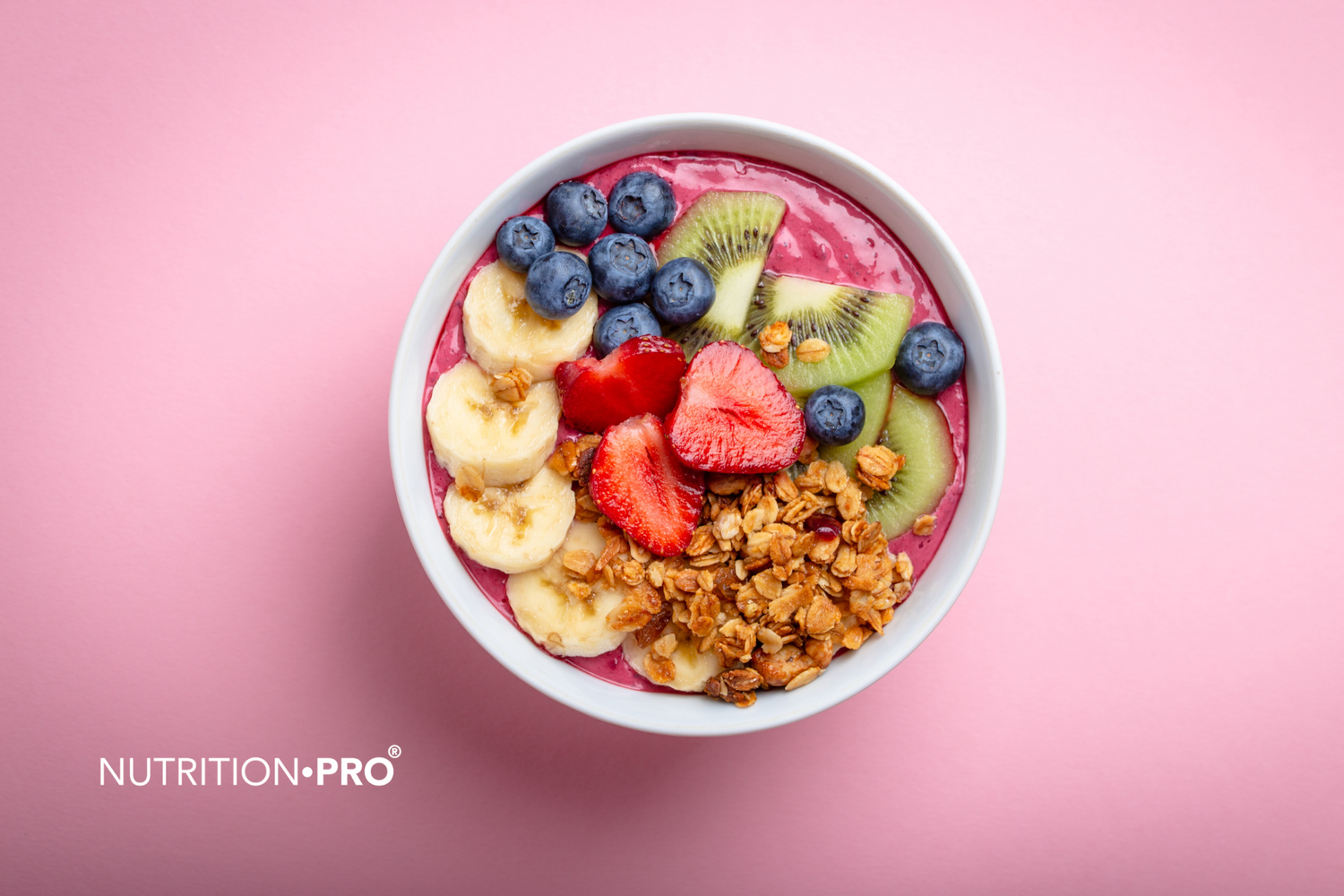
If you've ever tried making an acai bowl at home, you probably know the result: a purple smoothie in a bowl, with toppings sliding off instead of staying put. Nothing like the thick, spoon-able texture of store-bought bowls.
It's not a matter of recipe, it's a matter of technique, and it comes down to three easy-to-fix mistakes. This article gives you the precise recipe, explains why each step matters, details what's really in a commercial bowl compared to a homemade one, and offers variations that work.

For 1 bowl, 8 minutes. 1 large frozen banana sliced into rounds (120 g), 2 tablespoons acai powder (12 g), 80 g frozen berries, 30 to 60 ml of cold plant-based beverage. Pour the liquid first, add the frozen fruit next, blend in pulses while scraping the sides, and don't add extra liquid to help.
The three mistakes that make the bowl watery. Fruit that's cold but not frozen. Too much liquid from the start, or added during blending. Continuous blending, which warms the mixture instead of structuring it. The key indicator: the spoon should stand straight up. The real nutritional issue: it's not the acai, which is low in sugar, it's the toppings and added syrups.
The recipe, step by step
The ingredients
| Ingredient | Quantity | Its role |
|---|---|---|
| Frozen banana slices | 1 large, about 120 g | The structure of the bowl. It provides creaminess, body and sweetness. It's the non-negotiable ingredient |
| Açaí powder | 2 tablespoons, about 12 g | The color, characteristic flavor and density |
| Frozen berries | 80 g | Acidity, freshness, and extra cold for texture |
| Well-chilled plant-based milk | 30 to 60 ml, no more | Only to prime the blades. This is not a flavor ingredient |
| Nut butter | 1 tablespoon, optional | Creaminess and satiety, without added liquid |
The preparation
Why your bowl is liquid: the three mistakes
An acai bowl is not a smoothie served in a bowl. It's a frozen preparation, whose structure relies on fine ice crystals retained in a creamy mixture. Anything that melts or dilutes this structure destroys it.
| The mistake | What happens | The correction |
|---|---|---|
| 1. Fruit that's cold, not frozen | Without ice crystals, no structure is possible. You get a liquid puree, no matter what comes next | Complete freezing, minimum four hours, slices spread flat |
| 2. Too much liquid | Every millilitre beyond what's necessary melts the crystals and dilutes the preparation, irreversibly | Start with 30 ml, add only by the tablespoon and only if the blender gets stuck |
| 3. Continuous blending | The blades and motor produce heat, which warms the preparation while you blend it. The more you push, the more it liquefies | Short pulses, frequent stops, scraping with a spatula |
The three mistakes reinforce each other, and this is what makes failure so common. Fruit that isn't cold enough jams the blender, which pushes you to add liquid, which makes the preparation blend longer, which warms it further. After two minutes, you have a smoothie.
Getting out of this circle is counterintuitive: when the blender jams, the right reaction isn't to add liquid but to stop and scrape. In nine cases out of ten, the problem isn't a lack of liquid, it's an air pocket under the blades.
Blender technique, in detail
Not all blenders are equal for this preparation, but all can succeed. The method simply changes.
| Your appliance | The adapted method |
|---|---|
| Powerful blender with pusher | The ideal case. Use the pusher to bring the mixture toward the blades without stopping. You can go down to 30 ml of liquid, sometimes less |
| Standard blender | Short pulses and scraping with a spatula between each. Count on 60 ml of liquid and a bit of patience |
| Mini-blender or individual bowl | Cut the fruit smaller before freezing and work in two batches if the bowl is narrow. These appliances struggle with large hard chunks |
| Food processor with blade | Works well, provided you scrape very often. The large bowl promotes air pockets |
| Immersion blender | The most difficult. Let the fruit soften for two minutes, work in a narrow and tall container, accept a slightly less firm texture |
Three tips that change the result
- Take the fruit out at the last moment. Five minutes on the counter is enough to soften the surface and lose texture. Prepare everything else before opening the freezer.
- Chill the blender bowl. If it's summer or if the appliance was just used, run the bowl under cold water and dry it. A warm bowl melts your preparation from the inside.
- Replace part of the liquid with a cold and thick ingredient. A spoonful of Greek yogurt, skyr, or fresh cheese adds creaminess without diluting as much as the same quantity of plant-based beverage.
Homemade or store-bought: what really changes
Many people assume an açaí bowl is high-calorie because of the açaí. It's the opposite: acai pulp is one of the least sugary fruits, with a moderate sugar content, which also explains its low sugar taste, almost earthy, which surprises on first tasting. We detail this atypical composition in our complete guide to acai.
What drives up a bowl, then, are the additions, and they come in two types.
| Type of addition | Where it hides |
|---|---|
| In the base itself | Many commercial preparations, in frozen packets or powder form, are naturally sweetened: sugar, guarana syrup, concentrated juices, maltodextrin. This is invisible in the bowl served |
| In the toppings | Granola, honey, agave syrup, condensed milk, nut butter, dried fruits. Generous toppings can double the bowl's caloric content |
When you buy powder or pulp, read the ingredient list: a quality base contains only acai. When you order a ready-made bowl, the variable you control is the toppings, and that's where it really matters.
Homemade from a pure base, the bowl in this recipe represents approximately 210 kcal without toppings, estimate for the base alone. The same bowl covered with granola, honey and nut butter can easily exceed double. That's not a problem in itself, it's simply information to have.
Toppings, classified by what they provide
| Topping | What it provides | Good to know |
|---|---|---|
| Fresh sliced fruit | Freshness, color, fiber, volume | The simplest and least energy-dense option |
| Chia, flax, and pumpkin seeds | Fiber, crunchy texture, lipids | One spoonful is more than enough |
| Walnut and almond pieces | Crunch, lipids, satiety | Energy-dense: measure by the spoon, not by the handful |
| Coconut flakes | Texture and flavor | Check that they are not sweetened, it's common |
| Nut butter | Creaminess and satiety | Prefer a single-ingredient puree, with no added sugar or palm oil |
| Granola | Crunchy, cereals | It's the sweetest addition in the aisle: read the label, the differences between brands are huge |
| Honey, agave syrup | Sweetness | Often unnecessary if the banana is ripe enough: taste before adding any |
Five variations that work
| Variation | What we change | The technique adjustment |
|---|---|---|
| Protein bowl | Add a scoop of whey isolate or plant-based protein to the base | The powder absorbs liquid: add 15 ml more, and blend a little longer |
| No banana | Replace with 120 g frozen mango plus 2 tablespoons of avocado | The avocado replaces the creaminess of the banana, the mango adds sweetness. Reduce the liquid to 30 ml |
| Extra creamy | Replace the plant-based milk with 60 g Greek yogurt or skyr | No added liquid at all. It's the thickest version possible |
| Express version | Use a store-bought frozen mixed berry blend in place of the banana | Less creamy because there's no banana: compensate with a spoonful of almond butter |
| Green bowl | Add a handful of frozen spinach to the base | The color turns dark purple, the taste changes little. Freeze the spinach, never use it fresh |
Two principles govern all these variations. The first: any added ingredient must be cold or frozen, without exception. The second: each dry ingredient added requires a little more liquid, but always by the tablespoon, never in a stream.
Prepare ahead and store
An acai bowl cannot be kept once blended: the crystal structure breaks down when thawed, and refreezing creates a hard, grainy block that cannot be worked with properly. On the other hand, everything else can be prepared in advance, and that's what makes the recipe realistic during the week.
A successful acai bowl is about cold, little liquid, and patience when blending. Nothing else. The recipe matters less than the technique, and the test is immediate: if the spoon stands upright, you've succeeded. The rest, toppings included, is just comfort.
Frequently asked questions
The texture
Why is my acai bowl too liquid?
Three possible causes, and they often accumulate together. The fruits were cold but not completely frozen, which prevents any structure. You added too much liquid at the start, or you added more while blending. Or you blended continuously, which heats the mixture through friction from the blades and motor. The fix: complete freezing, maximum 30 to 60 ml of liquid, and pulse blending.
How do I know if my bowl is successful?
Insert a spoon in the middle. If it stands upright, the texture is good. If it tilts or falls, there was too much liquid or the fruits weren't frozen enough. This is the only test you need, and it's immediate.
What should I do if the blender gets stuck?
Stop and scrape the sides with a spatula to push the mixture toward the blades. In the vast majority of cases, the problem isn't a lack of liquid but an air pocket under the blades. Adding liquid at that moment is the most common reflex, and it's precisely what turns a bowl into a smoothie.
Do I need a powerful blender?
No, but the method changes. With a powerful blender equipped with a tamper, you can go down to 30 ml of liquid or even less. With a standard blender, plan for 60 ml, short pulses, and scraping between each. With an immersion blender, it's more difficult: work in a narrow, tall container and accept a slightly less firm texture.
Can you make an açai bowl without banana?
Yes, but you need to replace what it provided, namely creaminess and sweetness. The combination that works best is 120 g of frozen mango with two tablespoons of avocado: the mango provides sweetness, the avocado provides creaminess. Reduce the liquid to 30 ml, as the avocado already contributes some.
Why freeze the banana in slices?
Because a completely frozen banana doesn't blend properly and risks damaging the blades. Slices about one centimeter thick, spread flat on a plate without touching, freeze separately and blend easily. Once solid, they can be stored in a bag without clumping.
Ingredients and shopping
Powder or frozen pulp, which should you choose?
Both work. Frozen pulp in a packet provides extra cold, which helps the texture, but it's often naturally sweetened and takes up freezer space. Powder keeps at room temperature, can be dosed freely, and lets you control exactly what's inside, provided you choose a single-ingredient powder.
How do you recognize a good açai powder?
First, check the ingredient list: quality powder contains only açai pulp, with no sugar, maltodextrin, flavoring, or coloring. Next, look at the drying process—freeze-drying better preserves anthocyanins, which are heat-sensitive. Finally, color is an indicator: deep purple is better than a dull or brownish tint.
How much powder for one bowl?
Two tablespoons, or approximately 12 g, give a strong color and present flavor without overpowering. Below that, the color fades and açai disappears behind the red fruits. Above that, the earthy taste becomes dominant, which not everyone enjoys. Also follow the usage instructions on your product's label.
Why doesn't my bowl have the color from the photos?
Two possible explanations. The powder may be diluted with other ingredients, reducing pigment concentration. Or it underwent high-temperature drying that degraded anthocyanins, pigments sensitive to heat. Quality powder gives a deep purple with just two tablespoons. Also note that added red fruits modify the final shade.
Can you use açai juice?
It's not recommended for a bowl, precisely because it's a liquid. The principle of the recipe is to minimize added water: replacing powder with juice means adding exactly what you're trying to avoid. Commercial açai juices are also frequently sweetened and diluted.
Nutrition
Is an açai bowl high in calories?
It depends almost entirely on the toppings. The base of this recipe represents about 210 kcal, estimate excluding toppings. The same bowl covered with granola, honey, and nut butter can easily exceed double that. This isn't a problem in itself; it's information to have before composing your bowl.
Is açai sweet?
Not much, and that's what surprises most people on first tasting. Açai pulp has a moderate sugar content for a fruit and an almost earthy, slightly cocoa-like flavor. This is precisely why commercial preparations frequently add sugar, syrup, or concentrated juices to it.
Why are commercial bowls so sweet?
The sugar comes from two distinct sources. In the base itself, many commercial preparations are naturally sweetened, which is invisible in the served bowl. And in the topping, with granola, honey, syrups, and dried fruits. Making your own bowl from a pure base radically changes the nutritional profile.
Can it be a complete breakfast?
The base alone is essentially composed of fruit, so it's relatively light in protein. To make it a more satisfying meal, add a protein source to the base—a serving of whey or plant-based protein—or replace the liquid with Greek yogurt or skyr. Nuts in the topping, as butter or pieces, also add satiety.
Is it suitable for vegan diets?
The basic recipe is, provided you use plant-based milk. For the extra creamy version, replace the Greek yogurt with thick plant-based yogurt like coconut or soy. For the protein version, use plant-based protein rather than whey.
Organization
Can you prepare an açai bowl in advance?
Not once blended: the crystal structure breaks down and refreezing creates a hard, grainy block. However, everything else can be prepared ahead. Compose individual bags in the freezer with banana slices, red fruits, and pre-portioned powder: in the morning, just pour a bag into the blender. Preparation time drops to two minutes.
How long does it keep?
It's eaten immediately. An açai bowl starts to melt within a few minutes, and the texture is better at the first spoonful than at the last. This is also why you should chill the serving bowl in the freezer while blending.
What do you do with overripe bananas?
Freeze them—that's exactly the right use. The riper a banana is, the sweeter and creamier it becomes once frozen, which improves the bowl and avoids adding honey. Cut into slices, freeze flat on a plate, then store in a bag. They keep for several months.


