

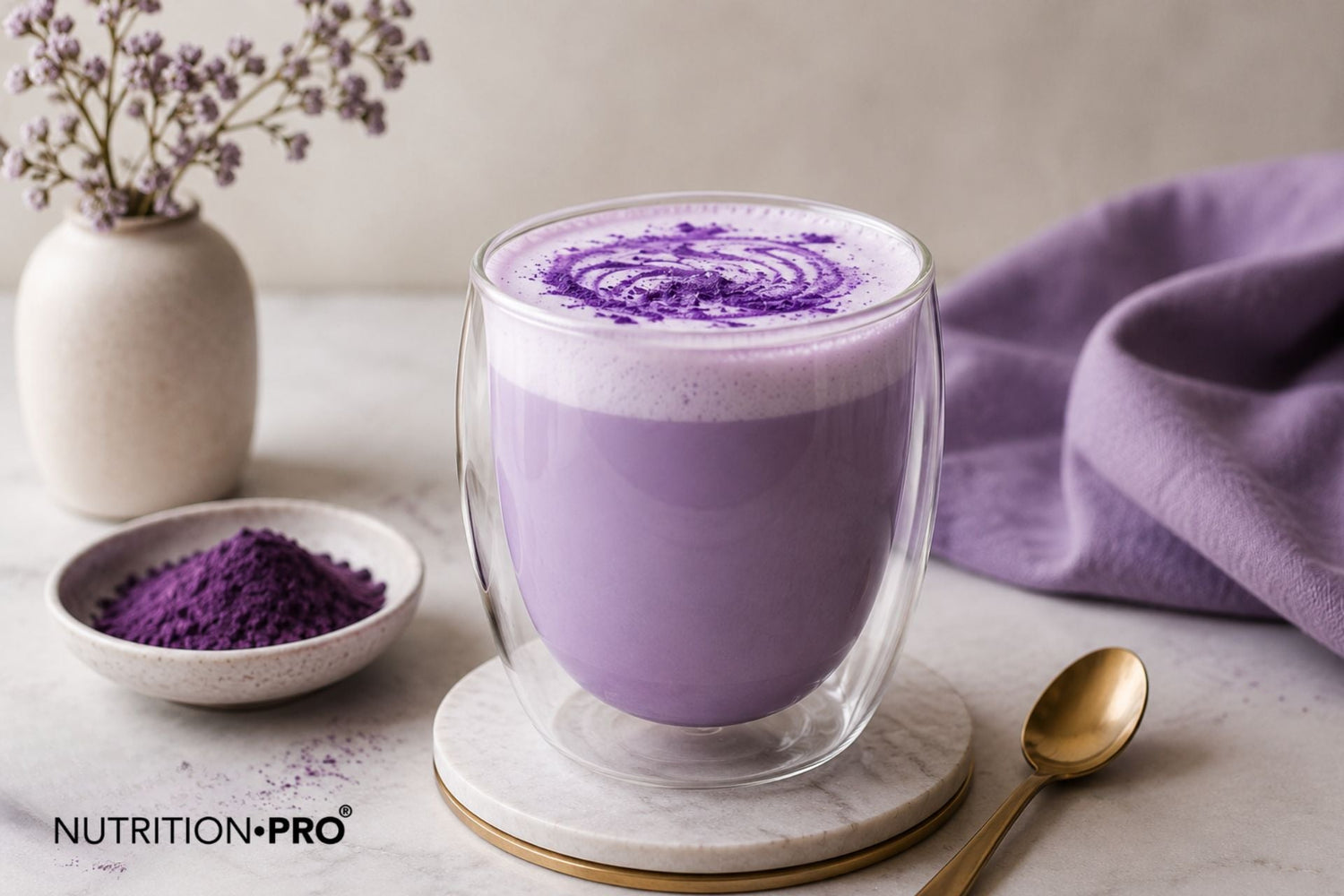
You've definitely come across it on Instagram or on a coffee shop menu: the ube latte, this spectacularly purple drink that outshines matcha. Behind the color lies a simple question: what exactly is it, and how do you make it at home?
Good news: the ube latte is one of the easiest drinks to prepare, and one of the mildest. In this guide, we explain what an ube latte is, the step-by-step recipe (hot or iced), its benefits, its calories, how it compares to matcha latte, and where to drink one or make it yourself.

One teaspoon is enough for a purple, smooth, and caffeine-free ube latte. 100% purple yam powder, organic, with no added sugar or coloring: the ideal base for a controlled homemade latte.
The ube latte is a milk-based drink made withube (purple yam), recognizable by its natural purple color, sweet and vanilla flavor, and caffeine-free. To make it at home: dissolve 1 teaspoon of ube powder in a little hot water, add a sweetener, then hot or cold plant-based milk. Expect around 100 to 180 kcal for a lightly sweetened homemade version. In terms of antioxidants, it provides the anthocyanins from ube. Compared to matcha latte, it's smoother, without bitterness and without caffeine. You can find it in coffee shops in major cities, or make it yourself in 5 minutes.
1. What is an ube latte?
Theube (Dioscorea alata) is a purple yam native to the Philippines, with purple flesh and a sweet, slightly vanilla taste. The ube latte is its beverage version: ube, in powder or puree form, mixed with milk (most often plant-based: oat, almond, coconut) and a touch of sweetener. The result is a creamy beverage with a vibrant purple color, naturally colored by ube pigments.
Its great advantage: it is caffeine-free, unlike coffee or matcha. It's a pleasure drink, sweet and comforting, that you can enjoy at any time of day. Its spectacular color has made it a star of coffee shops and social media, to the point of becoming the purple counterpart to matcha latte. To learn all about the ingredient, see our ube guide.
2. The ube latte recipe (hot or iced)
The ube latte is one of the easiest beverages to make. The only key tip: dissolve the ube powder in a little hot liquid first, to obtain a smooth paste without lumps, before adding the milk. Here's the basic recipe, which can be made hot or iced.
Ube latte (hot or iced)
A purple, sweet, and caffeine-free beverage, ready in 5 minutes.
Ingredients
- 1 tsp ube powder (or 2 tbsp ube puree)
- 200 ml plant-based milk (oat, almond, or coconut)
- 1 tsp maple syrup or coconut syrup
- 1 pinch vanilla powder (optional)
- Ice cubes for the iced version
Preparation
- Dissolve the ube powder in a small amount of hot water until you achieve a smooth paste.
- Add the syrup and vanilla, mix well.
- Hot version: add the hot plant-based milk and whisk. Iced version: pour over ice cubes then top with cold milk.
- Enjoy immediately, optionally with a splash of coconut cream.
Foaming tip: if you have a milk frother, froth the plant-based milk before adding it for a latte worthy of a coffee shop. Using ube puree rather than powder, blend everything in a blender for a perfectly smooth texture.
3. Variations: ube matcha, vegan, toppings
Once you've mastered the basics, have fun:
Ube matcha latte: the trendy combination. Prepare a matcha base (1 teaspoon of matcha dissolved) and an ube base separately, then layer them in the glass for a spectacular green-purple gradient. You get both the sweetness of ube and the invigorating plant-based aspect of matcha.
Vegan version: it's already virtually the standard, since ube latte is made with plant-based milk. Just verify that your sweetener is plant-based (maple, coconut, or agave syrup rather than honey).
Toppings: a dollop of whipped coconut cream, shredded coconut flakes, a pinch of black sesame, or a drizzle of syrup on top. For the iced version, a layered latte (milk, then ube base) creates a nice visual effect.
4. Ube latte or matcha latte: which one to choose?
This is the comparison everyone wonders about, as both are the star colored beverages of the moment. Here are their differences at a glance:
Ube latte
The purple drink
Color
Natural purple (ube anthocyanins)
Taste
Sweet, vanilla-flavored, no bitterness
Caffeine
None
Ideal for
A comforting drink any time of day
Matcha latte
The green drink
Color
Green (ground green tea)
Taste
Plant-based, slightly bitter
Caffeine
Yes, progressive energy
Ideal for
A morning or midday energy boost
In summary: choose the ube latte for its sweetness and lack of caffeine (perfect in the afternoon or evening), and the matcha latte if you're looking for a gentle stimulant. And nothing stops you from combining them into an ube matcha latte. Both provide antioxidants, in different forms.
5. What are the benefits of ube latte?
The main nutritional interest of ube latte comes from the ube itself, and more specifically from its anthocyanins, the purple pigments that are antioxidants. According to PubMed, their antioxidant activity has been confirmed directly in ube (Moriya 2015, DOI: 10.1080/09168451.2015.1027652). Ube also provides fiber, beneficial for digestive comfort (Barber 2020, DOI: 10.3390/nu12103209).
Its most concrete advantage remains practical: it's a sweet and caffeine-freebeverage that can replace an afternoon coffee or soda with something more interesting. Let's be honest: an ube latte is primarily a pleasure drink. Its value depends mainly on what you put in it (milk, sugar). It cannot be attributed any therapeutic properties. For the complete food profile, see our guide to the benefits of ube.
6. How many calories in an ube latte?
The number of calories in an ube latte depends almost entirely on the ingredients, not the ube (which represents only a teaspoon). A few reference points:
A light homemade version (unsweetened almond milk, 1 tsp ube powder, little syrup) sits around 100 to 180 kcal per cup. With richer milk (oat, coconut) or more sweetener, it goes up. Coffee shop versions, often sweetened, sometimes with whole milk and topped with whipped cream, can exceed 300 kcal, like any other indulgent latte drink.
The advantage of making it yourself: you control everything. By choosing unsweetened plant-based milk and measuring out the syrup, you get a colorful and delicious drink without excess sugar. The color and sweetness come partly from the ube, which allows you to reduce added sugar.
7. Where to drink or buy an ube latte?
Ube latte has spread to trendy coffee shops and Asian or healthy cafés in major cities. In Paris, Lyon, Bordeaux, Lille, Marseille, Toulouse or Nice, you'll find it especially in specialty stores offering original beverages, bubble tea or Asian pastries. Availability remains variable: ube is not yet as widespread as matcha.
The simplest, most economical and healthiest solution is to prepare it at home. With a jar of ube powder, you can make dozens of lattes for the price of two or three from a café, and you control the sugar and milk. You just need good quality ube powder: 100% purple yam, no additives.
Our organic ube powder is ideal for lattes: one teaspoon per cup is enough. To learn everything about the product and how to use it, see our guide to ube powder.
Frequently Asked Questions
What is an ube latte?
An ube latte is a milk-based drink made with ube (purple yam), recognizable by its natural purple color. It blends ube powder or purée with milk (often plant-based), with a little sweetener. Sweet, vanilla-flavored and caffeine-free, it's served hot or iced. It's the purple equivalent of matcha latte.
Does ube latte contain caffeine?
No. Ube is a tuber, it contains no caffeine. The classic ube latte is therefore a caffeine-free drink, making it an interesting alternative to coffee or matcha latte, especially in the afternoon or evening. Be careful, however, of "ube coffee" versions that add an espresso shot.
What does ube latte taste like?
Ube has a mild, slightly vanilla and nutty flavor, similar to sweet potato or chestnut. The ube latte is therefore a sweet and comforting drink, naturally somewhat sweet, with no bitterness. This is what distinguishes it from matcha latte, which is more vegetal and bitter.
How many calories in an ube latte?
It depends on the ingredients. A homemade ube latte with unsweetened plant milk and little syrup typically comes to around 100 to 180 kcal per cup. Coffee shop versions, with syrups, whipped cream and whole milk, can easily exceed 300 kcal. The homemade version allows you to control sugar and calories.
How to make an ube latte without powder?
You can use ube purée instead of powder: count about 2 tablespoons of purée per cup, blended with the milk for a smooth texture. Alternatively, some people use ube extract, but be careful—many are mostly colorants and flavorings: prefer real ube (powder or purée).
Information from PubMed, cited for informational purposes on ube and its components.
- Moriya C, Hosoya T, Agawa S, et al. New acylated anthocyanins from purple yam and their antioxidant activity. Biosci Biotechnol Biochem 2015;79(9):1484-92. DOI: 10.1080/09168451.2015.1027652
- Barber TM, Kabisch S, Pfeiffer AFH, Weickert MO. The Health Benefits of Dietary Fibre. Nutrients 2020;12(10):3209. DOI: 10.3390/nu12103209


