

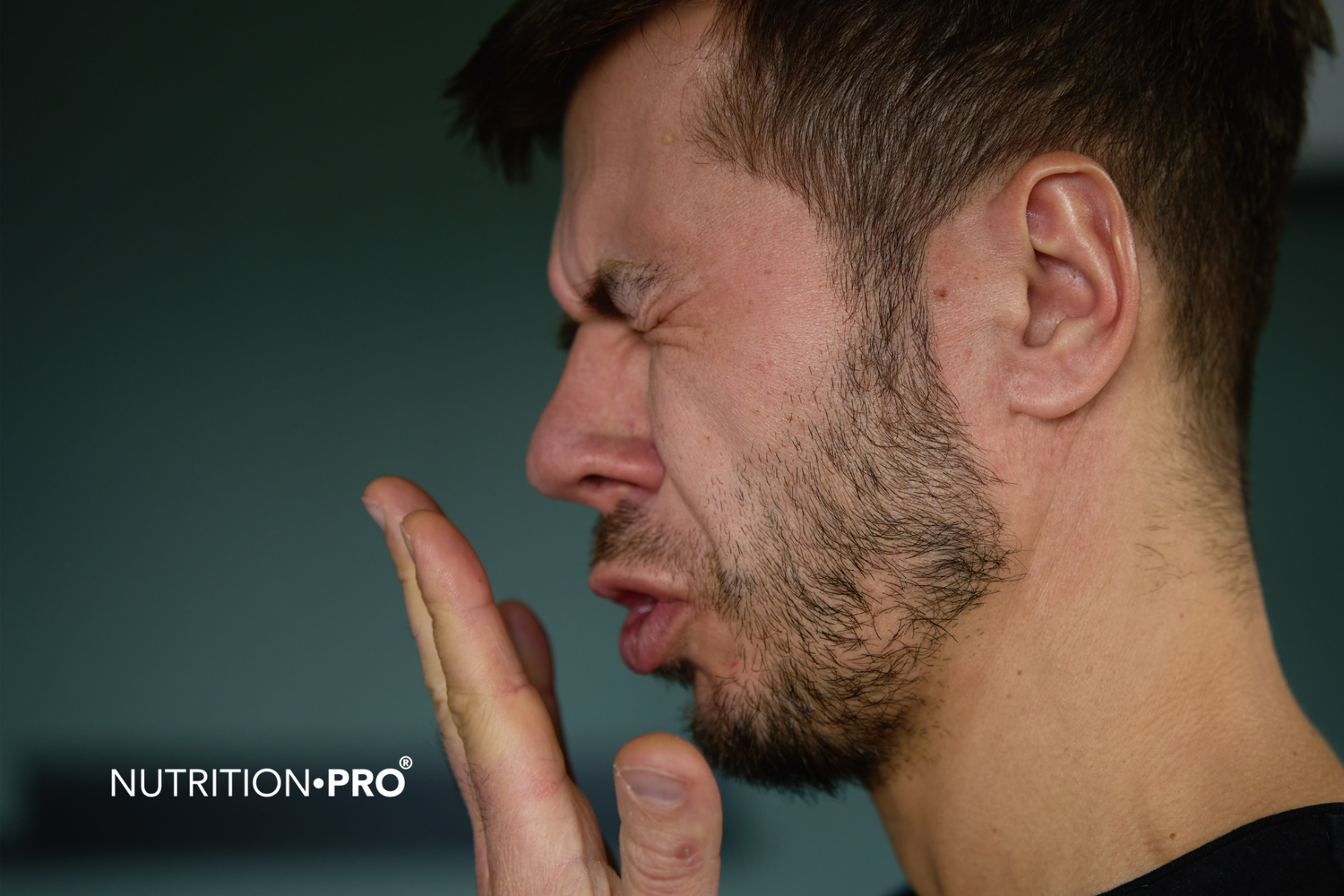
Bad breath — or halitosis — affects approximately one in two people occasionally or chronically. It is the third reason for dental consultation, just after cavities and periodontal disease. And yet, it is a topic that almost no one discusses openly.
What we now know thanks to recent clinical studies: in 80 to 90% of cases, bad breath originates from the mouth itself (coated tongue, plaque buildup, gingivitis), and not from the stomach as is often heard. The remaining 10 to 20% are linked to systemic causes: intestinal dysbiosis, ENT disorders, dry mouth, or liver problems. In this guide, we break down the 8 true causes of halitosis and the 5 natural active ingredients proven by meta-analyses to restore fresh breath lasting results.

Probiomix® — 60 capsules
6 probiotic strains + prebiotic FOS. To rebalance intestinal microbiota — an underestimated cause of persistent halitosis.
View Probiomix® →
Optimal Digest® — 500 ml
Lemon balm, rosemary, artichoke, fig, blueberry. Digestive and hepatic support in case of systemic halitosis.
View Optimal Digest® →80-90% oral-dental: according to Silva 2022 (Archives of Pediatrics), the vast majority of halitosis originates from the mouth (tongue, plaque, gums). Other causes: ENT, digestive, metabolic, liver.
Probiotics + tongue scraper: according to Huang 2022 (BMJ Open, meta-analysis of 7 RCTs), probiotics significantly reduce organoleptic scores (SMD -0.58) and CSV (SMD -0.26). Maximum effect in combination with a tongue scraper (Mei 2026, J Breath Res).
- Halitosis: what it really is
- The 8 causes of bad breath
- The key role of tongue scraping
- The 5 proven active ingredients: overview
- Active ingredient #1 — Multi-strain probiotics
- Active ingredient #2 — Zinc
- Active ingredient #3 — Spirulina and chlorophyll
- Active ingredient #4 — Turmeric and digestive support
- Active ingredient #5 — Psyllium and fiber
- Self-test: where does your bad breath come from?
- 30-day protocol for fresh breath
- Personalized decision table
- FAQ — All your questions about halitosis
Halitosis: what it really is
<<<29>>> Halitosishalitose refers to a persistent unpleasant odor emitted from the mouth. It is primarily caused by volatile sulfur compounds (VSC) produced by anaerobic bacteria in the mouth that break down dietary proteins.
Three types to distinguish.Intra-oral halitosis (80-90% of cases) originates from the mouth: lingual biofilm, plaque, cavities, gingivitis.Extra-oral halitosis (10-20%) comes from elsewhere: ENT, digestive, metabolic.Halitophobia refers to the belief of having bad breath when this is not actually the case — a distinct psychological disorder. Morning breath is not pathological: salivation decreases at night, bacteria proliferate. Brushing and tongue scraping are sufficient. Halitosis that persists after morning hygiene or reappears rapidly, however, is a signal of an imbalance that warrants investigation.
The 8 causes of bad breath
According to Silva 2022 (Archives of Pediatrics), the etiology of halitosis is multifactorial and largely dominated by oral and dental origins. Identifying the exact cause is key to sustainable resolution.
1. Lingual bacterial biofilm (cause #1)
This is the primary cause. At the back of the tongue, a bacterial biofilm forms rich in anaerobic bacteria that produce CSV.
2. Dental plaque and cavities
Dental plaque, tartar, untreated cavities, and deteriorated old fillings are significant bacterial foci.
3. Gum disease (gingivitis, periodontitis)
Gum inflammation and bone damage (periodontitis) create infected pockets that are highly productive of CSV. Specialized dental follow-up is necessary.
4. Dry mouth (xerostomia)
Saliva naturally cleanses the mouth. A dry mouth promotes bacterial proliferation. Causes: dehydration, mouth breathing, certain medications (antidepressants, antihistamines, antihypertensives), stress, aging.
5. Intestinal dysbiosis
An imbalanced microbiota produces malodorous compounds absorbed into the bloodstream, which are released through breath. An increasingly recognized cause, particularly in people with bloating or IBS. See our complete guide on the microbiota.
6. Chronic ENT disorders
Sinusitis, tonsillitis, post-nasal drip, tonsillar caseum: any ENT focus can trigger halitosis.
7. Lifestyle and diet
Tobacco, alcohol, coffee, garlic, onion, high-protein diets (ketosis), prolonged fasting, dehydration: all promote halitosis.
8. Metabolic and hepatic causes
Poorly controlled diabetes (fruity acetonic breath), hepatic insufficiency, chronic GERD: the least frequent causes but requiring medical diagnosis in case of persistent halitosis.
The key role of tongue scraping
The tongue scraper is probably the most effective daily gesture against halitosis. By eliminating the bacterial biofilm from the back of the tongue (up to 80% of CSV-producing bacteria), it dramatically reduces odors. Combined with oral probiotics, it is the best-documented strategy 2020-2026.
According to Mei 2026 (J Breath Res), an RCT on 80 participants compared 4 groups: control, probiotic (S. salivarius K12), tongue brushing, combination of both. After 4 weeks, the three active groups saw their CSV decrease significantly, but it was the combination of brushing + probiotic that produced the most marked and lasting effect.
How to properly use a tongue scraper
In the morning on an empty stomach, after brushing: stick out the tongue, place the scraper as far back as possible (without forcing), gently scrape from back to front across the full width, rinse between each pass and repeat 5 to 7 times. A teaspoon can work if you don't have a dedicated scraper. Consistency and reaching the back of the tongue = the two keys.
The 5 proven actives: overview
Here are the 5 best-documented nutritional active ingredients to support oral hygiene and combat halitosis. They work through complementary mechanisms: bacterial rebalancing (probiotics), chemical neutralization of VSCs (zinc, chlorophyll), anti-inflammatory action intestinal (turmeric) and digestive regularity (fiber). They complement — but never replace — basic oral hygiene.
Summary table — the 5 active ingredients ranked by strength of scientific evidence:
Multi-strain probiotics: proven active ingredient #1
The only recent meta-analysis demonstrating a significant effect on VSCs.
According to Huang et al. 2022 in BMJ Open, a meta-analysis of 7 randomized controlled trials confirmed that probiotics significantly reduce organoleptic scores (SMD -0.58) and volatile sulfur compounds (SMD -0.26) over 4 weeks, with sustained effect beyond on organoleptic scores. The most studied strains are Lactobacillus salivarius, Lactobacillus reuteri, Lactobacillus rhamnosus and Streptococcus salivarius K12 — all present in multi-strain formulas like Probiomix® (DOI : 10.1136/bmjopen-2022-060753).
Two complementary mechanisms
Probiotics work on two levels. At the orallevel, they displace VSC-producing bacteria by occupying their "ecological niche" and by secreting bacteriocins that inhibit them. The strain Streptococcus salivarius K12 is particularly studied for this action. At the intestinallevel, they rebalance the microbiota, reduce the production of systemic sulfur compounds absorbed into the bloodstream, and limit digestive inflammation that may indirectly promote halitosis.
The Probiomix® by Nutrition•pro combines 6 probiotic strains (Lactobacillus + Bifidobacterium) with prebiotic FOS, in a therapeutic dose of 17 billion CFU per 4 capsules daily. Recommended course: 1 to 3 months, in the morning on an empty stomach, alongside daily tongue scraping to maximize the effect on oral and intestinal VSC.
Zinc: chemically neutralize sulfur compounds
Zinc ion binds to malodorous molecules and blocks their volatilization.
The zinc is the reference active ingredient in most effective anti-halitosis mouthwashes. Mechanism: the Zn²⁺ ion binds chemically to volatile sulfur compounds (VSC) and neutralizes them. According to Dudzik et al. 2021 in Journal of Clinical Medicine, a crossover trial on 60 volunteers compared brushing alone vs brushing + zinc lactate mouthwash + tongue scraper: the combination significantly reduces VSC and organoleptic scores after 14 days (DOI : 10.3390/jcm10235532).
Local zinc vs oral zinc
Two complementary approaches. The local zinc (mouthwash, zinc toothpaste) acts immediately on mouth VSC. The oral zinc (as a dietary supplement, such as Zinc Nutrition•pro 60 capsules) corrects deficiencies that can contribute to intestinal barrier fragility and indirectly promote systemic halitosis. Zinc is also a cofactor in the regeneration of oral mucosa cells.
Recommended oral dose: 10 to 15 mg/day in a course of 1 to 3 months (to be taken with meals to limit nausea). Prolonged supplementation at high doses must be monitored as zinc can interfere with copper absorption.
Spirulina and chlorophyll: the natural deodorizer
The green pigment that neutralizes odors at the digestive level.
The chlorophyll has been used for decades as a natural internal deodorizer. It works in the digestive tract by binding to odorous compounds (sulfides, amines) and limiting their absorption into the bloodstream — thus preventing their release through breath. Spirulina is one of the most concentrated sources (up to 1% of its dry weight), with the added benefit of complete protein, bioavailable iron, and anti-inflammatory phycocyanin.
The Organic Spirulina Powder Nutrition•pro (3 to 5 g per day to be introduced gradually) is the simplest option. For those who dislike the taste, the Organic Spirulina in 120 tablets avoids the strong flavor. For more information on documented benefits, see our article 10 proven benefits of spirulina.
Chewing fresh parsley or fennel seeds after meals is the traditional version of this chlorophyll strategy — hence the practice in Indian restaurants of offering a mixture of aromatic seeds at the end of the meal.
Turmeric and digestive support: addressing systemic causes
For the 10-20% of halitosis cases that originate from the liver or digestive tract.
When halitosis persists despite impeccable oral hygiene, it is often necessary to look toward the digestive tract and liver. Chronic low-grade intestinal inflammation, an overloaded liver, moderate acid reflux, or marked dysbiosis can generate odorous compounds that are released through the breath. Turmeric (intestinal anti-inflammatory) and digestive support formulas are then particularly useful.
Turmeric: intestinal anti-inflammatory action
Curcumin, the active ingredient in turmeric, exerts documented anti-inflammatory action on the intestinal mucosa, strengthens the intestinal barrier (limits "leaky gut") and favorably modulates the microbiota. The Organic Turmeric Powder Nutrition•pro should be consumed with black pepper and a fat source to optimize its absorption (curcumin has very low bioavailability on its own). Effective dose: 500 mg to 1 g per day for 1 to 2 months.
Optimal Digest®: hepatic and digestive support
TheOptimal Digest® by Nutrition•pro combines five plants traditionally used to support digestion and liver function: lemon balm (soothing), rosemary (choleretic), artichoke (hepatic drainage), fig and blueberry. Liquid format for rapid absorption. To be taken before heavy meals or during periods of dietary overload. To deeply support liver function, the Organic Detox treatment can complement this approach for 1 to 2 months.
Psyllium and fiber: regular transit for fresh breath
Slow transit promotes foul-smelling fermentations. Normalizing transit means fewer systemic odors.
A slow or irregular transit prolongs the residence time of food residues in the colon, promotes excessive bacterial fermentations and the production of foul-smelling compounds that can enter the bloodstream. Mucilaginous fibers, of which blonde psyllium is the prototype, normalize transit gently without irritation, while nourishing beneficial intestinal bacteria.
The Organic Blonde Psyllium by Nutrition•pro is one of the purest and most concentrated sources of mucilaginous fiber. Dosage: 1 teaspoon (5 g) per day, to be introduced gradually, in a large glass of water (drink immediately). Visible effect on transit in 3 to 7 days.
The Organic Moringa powder provides another profile of prebiotic fibers + minerals and chlorophyll, doubly beneficial for halitosis. Also remember to increase dietary fiber (vegetables, legumes, whole grains) to aim for at least 25 g of fiber per day according to WHO recommendations.
Self-test: what is the source of your bad breath?
Check the statements that apply to you. Your dominant profile will point you toward the likely cause and appropriate approach.
30-day protocol for fresh breath
A structured 4-week protocol combines optimal oral hygiene (the foundation), probiotics (flora rebalancing), hydration and digestive support if necessary. First effects are generally visible within 7 to 14 days. If no clear improvement at 30 days, dental consultation is essential.
Week 1 — Optimal oral hygiene
- Brushing 2 times daily, fluoride toothpaste, gentle method for 2 minutes
- Dental floss or interdental brushes every evening (neglected key area)
- Tongue scraper every morning, from back to front, 5 to 7 strokes
- Mouthwash with zinc optional, 1 time daily
Week 2 — Probiotics and hydration
- Probiomix® 4 capsules in the morning on an empty stomach (30 min before breakfast)
- 1.5 to 2 L of water per day to stimulate salivation
- Sugar-free chewing gum after meals to stimulate salivation
- Reduce coffee, alcohol, tobacco which dry out the mouth
Week 3 — Digestive support and internal deodorizing
- Optimal Digest® before heavy meals if digestive symptoms
- Organic spirulina 3 g/day (deodorizing chlorophyll)
- Organic turmeric 500 mg/day if signs of digestive inflammation
- Increase fiber intake (vegetables, legumes, psyllium) to regulate digestive transit
Week 4 — Evaluation and consolidation
Assessment: test your breath (lick your wrist, smell your tongue scraper, ask a close friend). If there is clear improvement, continue the probiotic course for an additional 2 months as maintenance. If there is no significant improvement, dental consultation is mandatory to rule out cavities, gingivitis, or periodontitis. If oral health is sound and halitosis persists, consult your general practitioner for systemic evaluation (digestion, ENT, diabetes, liver).
Personalized decision chart
IF / THEN summary to quickly decide on the approach best suited to your situation.
FAQ — All your questions about halitosis
How do I know if I have bad breath?
Three reliable tests: lick the inside of your wrist and smell after 10 seconds, scrape the back of your tongue with a spoon and smell, or ask a close friend. Morning breath is physiologically more loaded, which is not pathological.
What is the real cause of bad breath?
According to Silva 2022 (Archives of Pediatrics), 80 to 90% of halitosis cases are oral and dental. The remaining 10-20%: ENT, digestive, metabolic (diabetes), liver, or lifestyle factors (fasting, tobacco, drying medications).
Do probiotics really help against halitosis?
Yes. According to Huang 2022 (BMJ Open, meta-analysis of 7 RCTs), probiotics reduce organoleptic scores (SMD -0.58) and VSC levels (SMD -0.26) over 4 weeks. Maximum effect combined with daily tongue scraping.
Is tongue scraping really effective?
Yes, probably the most effective daily measure. Lingual bacterial biofilm contains up to 80% of VSC-producing bacteria. Mei 2026 (J Breath Res) confirms: tongue brushing + probiotics = most marked effect.
Bad breath and stomach, myth or reality?
Rather a myth. The esophageal sphincter prevents gastric odors from rising. Exceptions: chronic GERD, gastritis, Helicobacter pylori, liver disorders. Less than 10% of persistent halitosis cases.
How long to regain fresh breath?
With rigorous hygiene: first effects in 7 to 14 days. For halitosis related to dysbiosis: 4 to 8 weeks. If no improvement at 30 days, dental consultation is imperative.
When to see a doctor for bad breath?
Dentist as priority (90% of cases) if halitosis persists after 4 weeks, bleeding gums, loose teeth. General practitioner if persistent dry mouth, fever, digestive issues, unexplained weight loss, intense thirst.
- Halitosis
- Medical term designating a persistent unpleasant odor emitted by the mouth. To be distinguished from physiological morning breath (transitory) and halitophobia (false conviction).
- Volatile sulfur compounds (VSC)
- Foul-smelling molecules produced by anaerobic bacteria in the mouth. The three main ones: hydrogen sulfide (rotten egg), methylmercaptan (rotten cabbage), dimethyl sulfide. Measured in the laboratory by gas chromatography.
- Lingual bacterial biofilm
- Complex layer of bacteria enclosed in mucus, which forms at the back of the tongue. Contains up to 80% of bacteria that produce VSC. Primary target of tongue scrapers.
- Xerostomia
- Abnormal dry mouth, usually due to decreased salivary production. Causes: dehydration, mouth breathing, medications, aging, stress, certain autoimmune diseases.
- Streptococcus salivarius K12
- Specific oral probiotic strain, naturally present in the mouths of people with healthy breath. Secretes bacteriocins that inhibit VSC-producing bacteria.
- Organoleptic score
- Clinical assessment scale for bad breath, measured by a trained judge who smells the air exhaled by the patient at 10 cm. Scale from 0 (no odor) to 5 (extremely strong odor).
- Tonsillar caseum
- Small foul-smelling whitish concretions formed in the crypts of the tonsils. Composed of food debris, dead cells, and bacteria. Frequent cause of intermittent halitosis.
- Huang N, Li J, Qiao X, Wu Y, Liu Y, Wu C, Li L. Efficacy of probiotics in the management of halitosis: a systematic review and meta-analysis. BMJ Open 2022;12(12):e060753. DOI: 10.1136/bmjopen-2022-060753
- Mei L, Yan F, Cheng L, Na A, Cannon RD, Guan G. Tongue brushing and oral probiotics for the treatment of halitosis: a randomized controlled trial. Journal of Breath Research 2026;20(1). DOI: 10.1088/1752-7163/ae3edc
- He L, Yang H, Chen Z, Ouyang X. The Effect of Streptococcus salivarius K12 on Halitosis: a Double-Blind, Randomized, Placebo-Controlled Trial. Probiotics and Antimicrobial Proteins 2020;12(4):1321-1329. DOI: 10.1007/s12602-020-09646-7
- Dudzik A, Sozkes S, Michalak E, Olszewska-Czyz I. Efficacy of a Zinc Lactate Mouthwash and Tongue Scraping in the Reduction of Intra-Oral Halitosis: A Single-blind, Controlled, Crossover Clinical Trial-A Pilot Study. Journal of Clinical Medicine 2021;10(23):5532. DOI: 10.3390/jcm10235532
- Silva CR, Silva CC, Rodrigues R. Etiology of halitosis in pediatric dentistry. Archives of Pediatrics 2022;29(6):467-474. DOI: 10.1016/j.arcped.2022.05.009


