

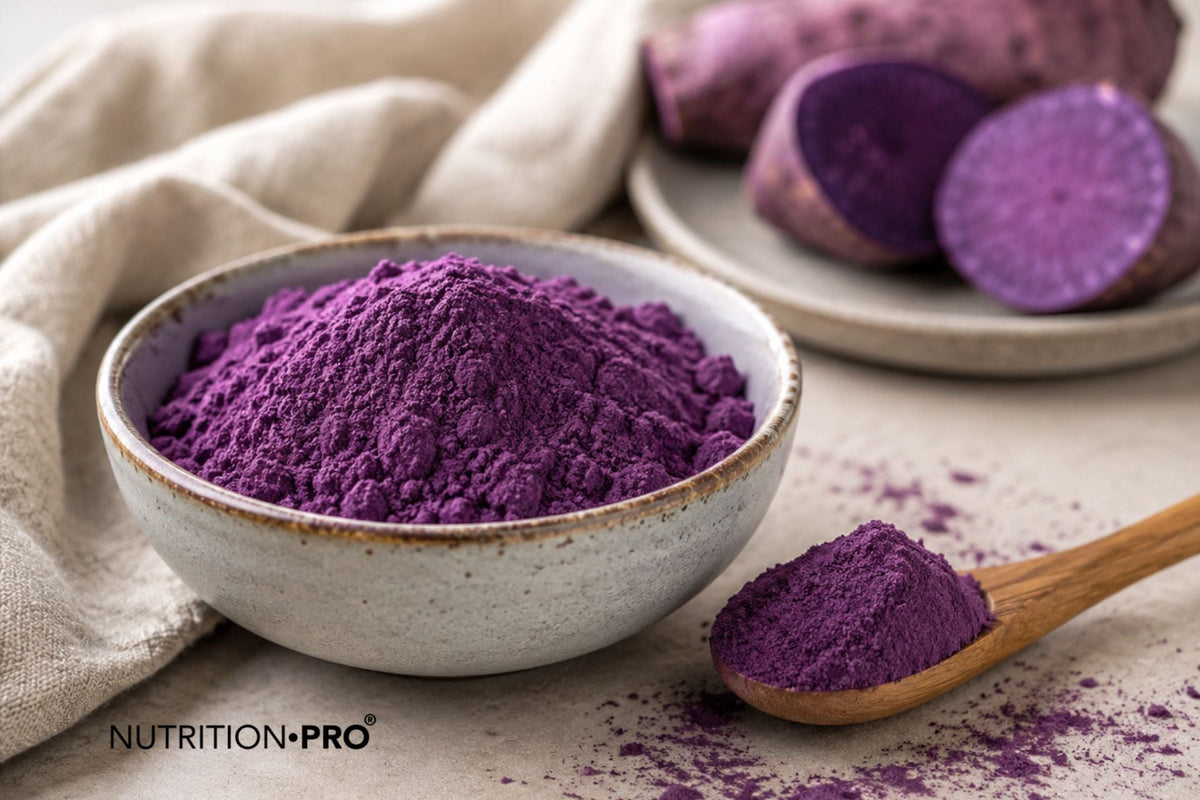
Ube powder is the simplest way to cook purple yam in France: a single spoonful is enough to color and flavor a drink, smoothie or cake, without having to peel, cook and blend a tuber that's difficult to find fresh. Convenient, long-lasting, easy to measure—it's the ideal format for enjoying ube every day.
But not all powders are created equal, and the market includes products that are artificially sweetened or colored. This guide explains how to choose it well, how to use and measure it, what it provides, and where to buy quality organic ube powder .

100% purple yam (Dioscorea alata), organic, from the Philippines. No added sugar, flavorings or colorants: just ube, ready to color and flavor your preparations.
Ube powder is purple yam that's been dehydrated then ground: convenient, it keeps for a long time and measures easily (1 to 2 teaspoons per serving). To choose well: aim for a powder that is 100% ube, organic, with no added sugar or colorants. It's used in lattes, smoothies, yogurts and baked goods, after simple rehydration in hot water for beverages. As for nutrients, it provides antioxidant anthocyanins and fiber. You can find it in Asian grocery stores, sometimes in health food shops, and online on superfood retailers.
1. What is ube powder?
Theube is a purple yam native to the Philippines, with purple flesh and a sweet taste, slightly vanilla-flavored. In its fresh form, it's a tuber that must be peeled, cooked, and then reduced to a puree: lengthy and difficult to find in France. The ube powder solves this problem. The tuber is dehydrated at low temperature then finely ground, resulting in a violet powder that preserves the characteristic color and aroma of the food.
Concretely, you simply need to rehydrate it with a little liquid to get an ube base usable in any recipe. It's the most practical form for regular use, and the one that made ube known outside of Asia. To learn everything about the food itself, see our complete ube guide.
2. Why choose powder over fresh?
Compared to fresh or frozen ube, powder has decisive advantages for use in France:
For coloring and flavoring a latte, smoothie, or cake, powder is unbeatable for convenience. Fresh remains interesting if you want a true homemade puree with substance, but for the majority of uses, powder does the job without the hassle.
3. How to choose your ube powder well
The ube powder market is uneven. Some powders are actually sweetened or colored blends, far from the original food. Here are the criteria that make quality powder:
100% ube, a single ingredient
The ingredient list should contain only ube (Dioscorea alata). No sugar, starch, flavor, or additives. If you read anything else, it's not pure powder.
Certified organic
The organic label guarantees cultivation without synthetic pesticides and supply chain traceability. A true mark of quality for an imported tuber.
No added sugar or coloring
The purple color should come from the ube itself (its anthocyanins), not from a colorant. Avoid mentions of "ube flavor" or "ube taste": they often signal the absence of real ube.
Clear and traceable origin
A stated origin (the Philippines are the reference for ube) testifies to a transparent supply chain. Powder with no specific origin is a bad sign.
Our organic ube powder checks all four criteria: 100% purple yam, certified organic, Philippines origin, with no additives whatsoever.
4. How to use ube powder
Ube powder is versatile. The only thing to remember: for a beverage or cream, rehydrate it first in a little hot water until you get a smooth paste, before adding the rest of the liquid. This prevents lumps. Here are the three most common uses:
One spoon, three uses
Ube powder is dosed at 1 to 2 teaspoons per serving
In a latte
Dissolve in a little hot water, then add hot or cold plant-based milk and a touch of maple syrup.
In a smoothie
Blend directly with a banana, plant-based milk and red fruits for a purple bowl.
In baking
Incorporate into the dry ingredients of your pancakes, cakes, creams or cheesecakes.
Beyond these three uses, the powder can be mixed into yogurt, porridge, dessert cream or crêpe batter. For detailed step-by-step recipes, consult our easy ube recipes (latte, ube halaya, pancakes, smoothie bowl, cake).
5. What ube powder provides
The nutritional interest of ube mainly comes from its anthocyanins, the purple pigments responsible for its color, which are antioxidants. According to PubMed, their antioxidant activity has been confirmed directly in ube: acylated anthocyanins were isolated from purple yam and their antioxidant capacity evaluated (Moriya 2015, DOI: 10.1080/09168451.2015.1027652). Ube also provides fiber, beneficial for digestive comfort (Barber 2020, DOI: 10.3390/nu12103209).
Let's be precise and honest: ube is a colored starch with a good profile, not a remedy. No therapeutic claims can be made about it. It's a good ingredient to include in a varied diet, for its taste qualities and its antioxidant content. For the complete details of its profile, see our article on the benefits of ube.
6. Where to buy organic ube powder
Several options are available to you for buying ube powder:
At Asian grocery stores: Some shops carry it, but quality and composition vary. Check the label carefully, sometimes only in English or Tagalog, to confirm it's pure powder and not a sweetened blend.
At health food stores: Ube remains rare in chains like Biocoop, but the superfood selection is expanding. Keep an eye on the powders and superfoods section.
Online: This is the most reliable option for finding quality organic ube powder, with clearly displayed composition and origin. Specialized supplement and superfood shops offer the best traceability guarantees.
Our organic ube powder meets all the quality criteria detailed above: pure purple yam, certified organic, no sugar or coloring, with traceable origin. It's the guarantee of enjoying real ube, not a adulterated product.
Frequently asked questions
How do you use ube powder?
Ube powder is dosed at 1 to 2 teaspoons per serving. For a beverage or cream, first dilute it in a little hot water to get a smooth paste, then add milk or liquid. For baking, incorporate it directly into dry ingredients. It colors and flavors lattes, smoothies, pancakes, yogurts and cakes.
What's the difference between ube powder and puree?
Puree is cooked and blended ube, ready to use but must be refrigerated and consumed quickly. Powder is ube that's been dehydrated then ground: it keeps for a very long time at room temperature, is easy to portion and transports well. For regular and practical use in France, powder is the simplest form.
How do you choose good ube powder?
Choose powder that's 100% ube (Dioscorea alata), preferably organic, with no added sugar, aroma or coloring. Check the ingredient list: it should contain only ube. A clear origin (Philippines) and organic certification are marks of quality.
Where can you buy organic ube powder?
Ube powder can be found in some Asian grocery stores, sometimes at health food stores, and more reliably online from specialized superfood shops. Always check that it's genuinely 100% ube powder with no additives. Nutrition•pro's organic ube powder meets these criteria.
How do you store ube powder?
Store ube powder in an airtight container, away from light, heat and humidity. When properly sealed, it keeps for several months without any problem. Avoid letting moisture in, which would cause the powder to clump.
Information from PubMed, cited for informational purposes on ube and its components.
- Moriya C, Hosoya T, Agawa S, et al. New acylated anthocyanins from purple yam and their antioxidant activity. Biosci Biotechnol Biochem 2015;79(9):1484-92. DOI: 10.1080/09168451.2015.1027652
- Barber TM, Kabisch S, Pfeiffer AFH, Weickert MO. The Health Benefits of Dietary Fibre. Nutrients 2020;12(10):3209. DOI: 10.3390/nu12103209


